Talc, Dolomite & Calcite Supplier in Rajasthan
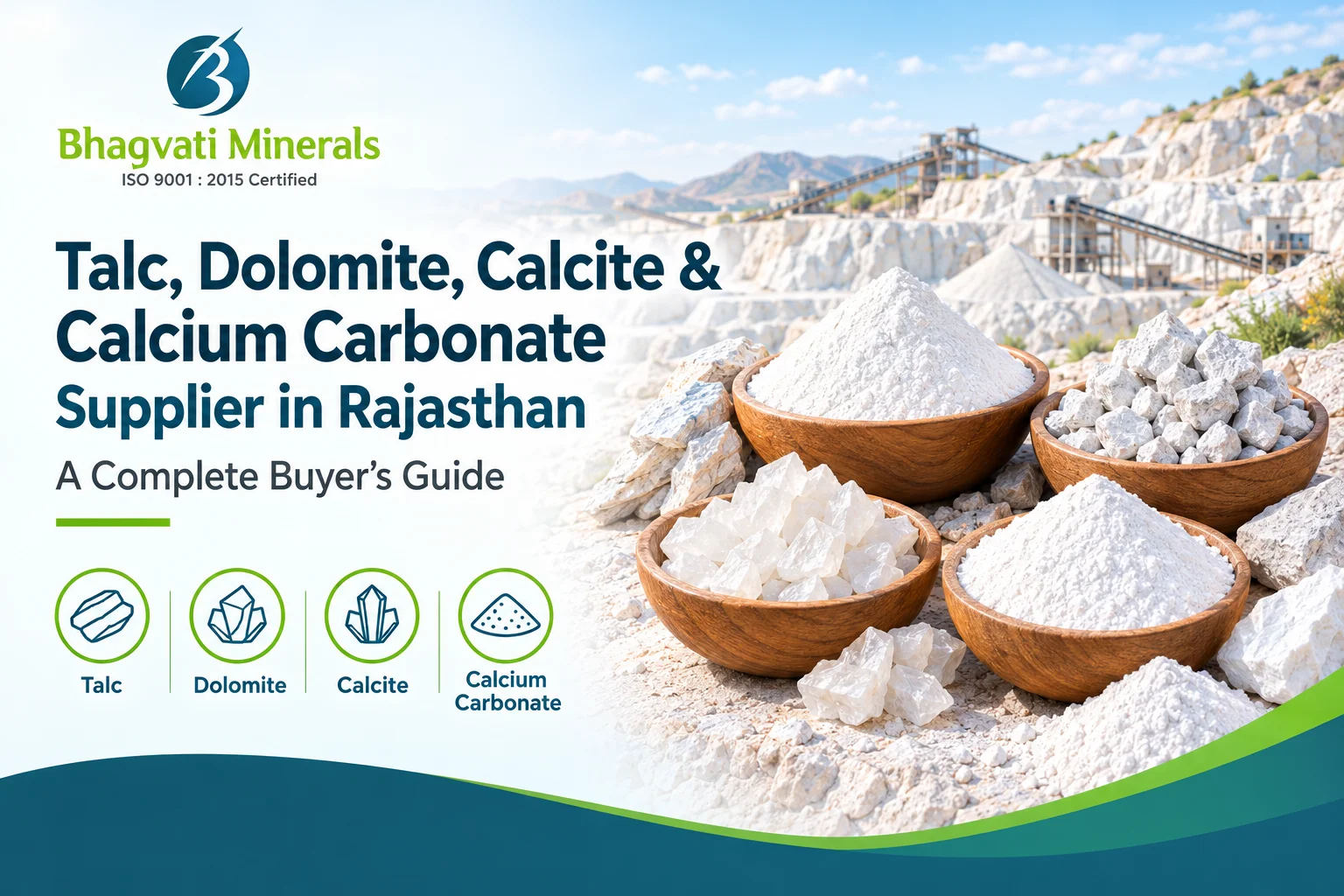
Talc, Dolomite, Calcite & Calcium Carbonate Supplier in Rajasthan: A Complete Buyer’s Guide
Choosing the right industrial mineral supplier is essential for maintaining product quality, improving manufacturing efficiency, and controlling production costs. Minerals such as talc, dolomite, calcite, and calcium carbonate are widely used in industries including paints, plastics, ceramics, construction, rubber, paper, and other manufacturing applications.
For businesses searching for a reliable talc, dolomite, calcite, and calcium carbonate supplier in Rajasthan, understanding mineral quality, applications, particle size, purity, and supplier reliability can help make the right purchasing decision.
Bhagvati Minerals provides mineral-related solutions for industrial requirements, helping buyers identify suitable mineral products for their applications. This guide explains the key characteristics of these minerals, their industrial uses, and the factors to consider before choosing a supplier.
Understanding Industrial Minerals and Their Importance
Industrial minerals are naturally occurring materials processed for use in different manufacturing and commercial applications. Their physical and chemical properties influence the performance, durability, appearance, and cost of finished products.
Talc, dolomite, calcite, and calcium carbonate are particularly important because they can serve as fillers, functional additives, and raw materials in various industries.
When sourcing these minerals, buyers should consider chemical composition, whiteness, moisture content, particle size distribution, and consistency between batches. Selecting the appropriate mineral grade can help manufacturers maintain product standards and improve production efficiency.
1. Talc Supplier in Rajasthan
Talc is a naturally occurring mineral known for its softness, smooth texture, and ability to improve the properties of various industrial products. Depending on its grade and processing, talc is used as a functional filler in several manufacturing sectors.
Industrial Applications of Talc
Paints and coatings: Helps improve surface finish, workability, and selected coating properties.
Plastics: Can improve stiffness, dimensional stability, and other formulation properties in suitable applications.
Paper manufacturing: Used as a filler and processing aid in certain paper grades.
Ceramics: Supports specific formulation and processing requirements.
Rubber: Used in selected rubber compounds and manufacturing processes.
What to Check Before Buying Talc
Industrial buyers should evaluate talc purity, brightness, particle size, moisture content, and suitability for the intended application. Consistent quality is particularly important for manufacturers working with standardized formulations.
If your business requires a dependable talc supplier in Rajasthan, choose a supplier who can provide relevant product specifications and help you identify the appropriate grade for your manufacturing needs.
2. Dolomite Supplier in Rajasthan
Dolomite is a mineral composed primarily of calcium magnesium carbonate. It is valued for its calcium and magnesium content and is used in several industrial and construction-related applications.
Common Applications of Dolomite
Construction: Used in selected construction materials and mineral-based products.
Glass manufacturing: Serves as a source of calcium and magnesium in suitable glass formulations.
Ceramics: Used in ceramic bodies and glazes, depending on the formulation.
Agriculture: Certain dolomite grades are used to help correct acidic soils and supply magnesium.
Industrial manufacturing: Used as a raw material or filler in selected processes.
How to Choose the Right Dolomite Grade
Before purchasing dolomite, check its calcium oxide and magnesium oxide content, silica levels, particle size, and moisture percentage. The required specifications depend on whether the mineral will be used in construction, ceramics, agriculture, or another industrial application.
Businesses looking for a dolomite supplier in Rajasthan should prioritize consistent material quality, suitable processing standards, transparent specifications, and dependable supply arrangements.
3. Calcite Supplier in Rajasthan
Calcite is a naturally occurring calcium carbonate mineral used in a wide range of industrial applications. Its properties make it useful in manufacturing processes where mineral composition, whiteness, and particle size are important.
Major Uses of Calcite
Paints and coatings: Used as a mineral filler to support opacity, texture, and formulation requirements.
Construction materials: Incorporated into selected cement-based and other building products.
Plastics: Used as a filler in suitable polymer formulations.
Ceramics: Applied in selected ceramic manufacturing processes.
Other industrial products: Used wherever the required calcium carbonate characteristics are suitable.
Factors to Consider When Buying Calcite
Buyers should assess calcium carbonate content, whiteness, brightness, fineness, moisture, and consistency. For applications requiring fine mineral powders, particle size distribution can significantly influence product performance.
A reliable calcite supplier in Rajasthan should be able to explain the available grades and provide product information that helps buyers select the right material for their specific industrial requirements.
4. Calcium Carbonate Supplier in Rajasthan
Calcium carbonate is one of the most widely used industrial mineral compounds. It is available in different grades and particle sizes, making it suitable for numerous manufacturing applications.
Depending on the production method and intended use, calcium carbonate may be supplied as ground calcium carbonate (GCC) or precipitated calcium carbonate (PCC). These materials can differ in particle characteristics, purity, and performance.
Industrial Applications of Calcium Carbonate
Paints and coatings: Calcium carbonate is used as an extender and functional filler to help achieve desired formulation properties.
Plastic manufacturing: It can improve stiffness and influence surface finish, processing behaviour, and production costs in suitable formulations.
Paper industry: Selected grades are used as fillers and coating pigments.
Rubber industry: Calcium carbonate can serve as a filler in suitable rubber compounds.
Construction industry: It is used in products such as putty, wall coatings, and other mineral-based building materials.
Adhesives and sealants: Appropriate grades may help control viscosity, consistency, and other formulation properties.
How to Select the Right Calcium Carbonate Grade
Before placing an order, consider calcium carbonate purity, particle size, whiteness, moisture, bulk density, and surface treatment where applicable. Fine and coarse grades can behave differently during processing, so product selection should match the intended use.
For manufacturers seeking a calcium carbonate supplier in Rajasthan, technical specifications and batch-to-batch consistency should be key considerations when comparing suppliers.
How to Choose the Best Industrial Mineral Supplier in Rajasthan
Selecting a supplier involves more than comparing prices. The right sourcing partner should understand your application and offer materials that meet your production requirements.
Consider the following factors before making a purchase:
Product quality: Review the mineral's chemical and physical specifications.
Application suitability: Confirm that the selected grade meets your manufacturing needs.
Quality documentation: Request a technical data sheet and certificate of analysis, where available.
Particle size options: Check whether the supplier offers suitable mesh sizes or fineness levels.
Supply consistency: Evaluate the supplier's ability to meet your regular quantity requirements.
Packaging and transportation: Confirm packaging options, delivery arrangements, and freight costs.
Competitive pricing: Compare the total delivered cost alongside quality and service.
These checks can help industrial buyers reduce sourcing risks and establish a more reliable raw-material supply chain.
Why Choose Bhagvati Minerals?
When sourcing industrial minerals, businesses need clear product information, suitable material specifications, and dependable communication. Bhagvati Minerals is a relevant point of contact for buyers exploring mineral products for industrial applications.
Before finalizing an order, discuss your application, required grade, quantity, particle size, packaging preferences, and delivery location with the supplier. Request the latest technical specifications to confirm that the product meets your quality standards.
To learn more about available products and mineral sourcing options, visit the official website: Bhagvati Minerals .
Conclusion
Finding the right talc, dolomite, calcite, and calcium carbonate supplier in Rajasthan can help businesses maintain manufacturing quality, optimize raw-material costs, and meet their production requirements. Each mineral offers different properties and applications, making grade selection an important part of the purchasing process.
By comparing specifications, checking quality documentation, and confirming supply capabilities, industrial buyers can make informed sourcing decisions.
If you are looking for industrial mineral products for your business, connect with Bhagvati Minerals to discuss your requirements and explore suitable product options.
Explore more: Visit Bhagvati Minerals to learn about available mineral products and sourcing options.
Frequently Asked Questions (FAQs)
1. What minerals are commonly used in industrial manufacturing?
Talc, dolomite, calcite, and calcium carbonate are commonly used in industries such as paints, plastics, ceramics, rubber, paper, and construction. Their suitability depends on the application and material grade.
2. How do I find a reliable talc supplier in Rajasthan?
Look for a supplier who can provide relevant product specifications, consistent quality, suitable particle sizes, clear pricing, and reliable delivery arrangements.
3. What is the difference between calcite and calcium carbonate?
Calcite is a naturally occurring crystalline mineral composed of calcium carbonate. Calcium carbonate is the chemical compound itself and can also be produced through industrial processes.
4. Which industries use dolomite powder?
Dolomite powder is used in selected construction, ceramics, glass, agricultural, and industrial applications. The appropriate grade depends on the required chemical composition and end use.
5. What should I check before purchasing mineral powder in bulk?
Check purity, particle size, whiteness where relevant, moisture content, packaging, quality documentation, minimum order quantity, and transportation costs.